

Successful businesses don’t always invent something new — they master the art of doing the same things differently.
Uber didn’t invent taxis.
Airbnb didn’t invent vacation stays.
Apple didn’t invent the phone.
But do you know what the common thread between them is? They identify existing solutions and turn them into better-designed, more convenient, tech-enabled, and customer-focused ones.
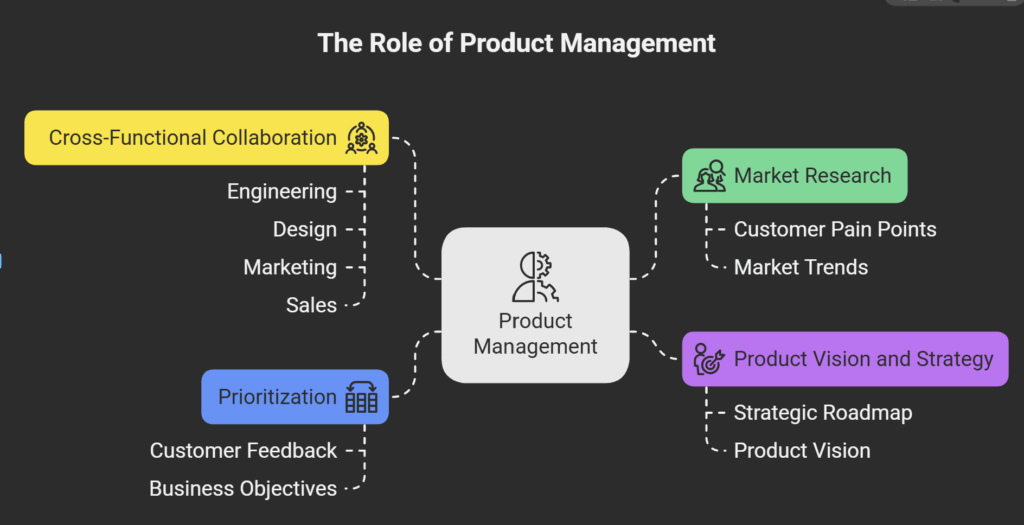
Starting a business is always an exciting step, but it can also be chaotic. With limited resources and an unlimited number of tasks, figuring out what to prioritise can be overwhelming. That’s where product management comes in. Even if you don’t have a full-time product manager (yet), following a product management mindset can help you move with clarity and focus in your crucial first year.
Whether you’re a solo founder or building a small digital team, here’s a startup-friendly Product Management Guide—with key priorities every business should know.
1. Build Your Business on Real Problems
The first crucial stepping stone for any business is to identify its objectives. Before you spend months building your MVP, ask: Is this a real problem for a real audience? Does your product or service address a genuine need, or is it something customers can easily overlook?
Too many startups fail because they build products that solve the wrong problem or address a tiny segment of the market. It is essential to understand that if your product solves a nice-to-have instead of a need-to-have, your customers will likely ignore it when times get tough or budgets get tight.
Tip:
- Conduct customer interviews at regular intervals.
- Use survey and poll data to understand pain points.
- Test hypotheses with no-code landing pages or mockups.
- Create your customer personas.
2. Define Your Minimum Viable Product ( MVP)
“Don’t rush the bus” is solid advice for many startups as they try to do too much in a short span, and don’t realise that it may set them back severely. To be successful in the long run, make sure that your first version of your product does one thing exceptionally well.
A simple MVP helps you launch faster, test smarter, and avoid wasting money on unnecessary features.
Tip:
- List features, then rank them using a value vs. effort matrix.
- Focus on the “must-haves” that directly support your core problem-solution fit.
3. Set Up Feedback Loops from Day One
It is industry practice that whenever a new website or app is launched, it is always tested. But what’s after that? It is always better to get your product into the hands of users early, but learning from their behaviour is even more critical.
Feedback is your fuel for iteration. Without it, you’re guessing in the dark.
Tip:
- Set up basic analytics (Google Analytics).
- Schedule regular calls or send feedback forms to early users.
- Use that feedback to improve onboarding, usability, or performance.
4. Create a Simple Product Roadmap
Running a business without proper planning can lead to a dead end. Without a roadmap, it’s easy to lose focus on unimportant tasks. And in contrast, if a proper roadmap is laid, it helps businesses identify essential tasks and prioritise them accordingly.
With proper planning and clear objectives, a business can focus its efforts in the right direction.
Tip:
- Define short-term (0–3 months), mid-term (3–6 months), and long-term (6–12 months) goals.
- Build flexibility into your roadmap for pivots.
- Share it with your team and advisors for accountability.
- Do regular digital audits to identify what’s working, what’s outdated, and what needs fixing.
Also Read: How Often Should You Run a Digital Audit? (Hint: It’s Not Once a Year)
5. Build a Circle of Continuous Learning
Learning should never be stopped, irrespective of where your business is on a growth curve. The first year of business is not just about launching; it’s about learning fast and iterating often.
When markets shift, so do economies. User behaviours shift as well. Successful startups stay agile by constantly learning.
PM Tip:
- Conduct cross-functional collaboration and idea sharing within the different teams.
- Have regular reviews with your team.
- Watch what worked, what did not work, and why.
Quick Tip:
In this fast-moving digital world, there is no scope for guesswork, because a small mistake can make your business lose its potential leads.
You don’t need a huge team or a big budget to practice good product management.
It’s a myth that Product management is just for big tech companies. In fact, it is equally beneficial for small-scale businesses as well. It’s a mindset and methodology that helps you scale with purpose, prioritise with confidence, and build products that matter. If you are just starting your business or stuck in the build-and-pivot loop, it might be time to bring product thinking in early.
Want to see how this applies to your industry? Check out how the publishing business can benefit from product management in this insightful blog post.