
Historically, SEO had the monopoly over how a website performed. Keyword stuffing was often the go-to tactic for ranking higher. But the rules of the game have changed now. AI drives the era, and all strategies must be redirected accordingly.
Earlier content was written with consumer behaviour in mind, considering what they were looking for and what they were searching for. But this strategy has taken a backseat. It’s all about writing content for AI search, anticipating how algorithms interpret and deliver results.
Today, AI-powered algorithms like Google’s BERT, MUM, and Search Generative Experience (SGE) focus on context, relevance, and intent.
Here’s how to optimize your content for AI Search Optimization:
1. Focus on Humans First, Content over Algorithms
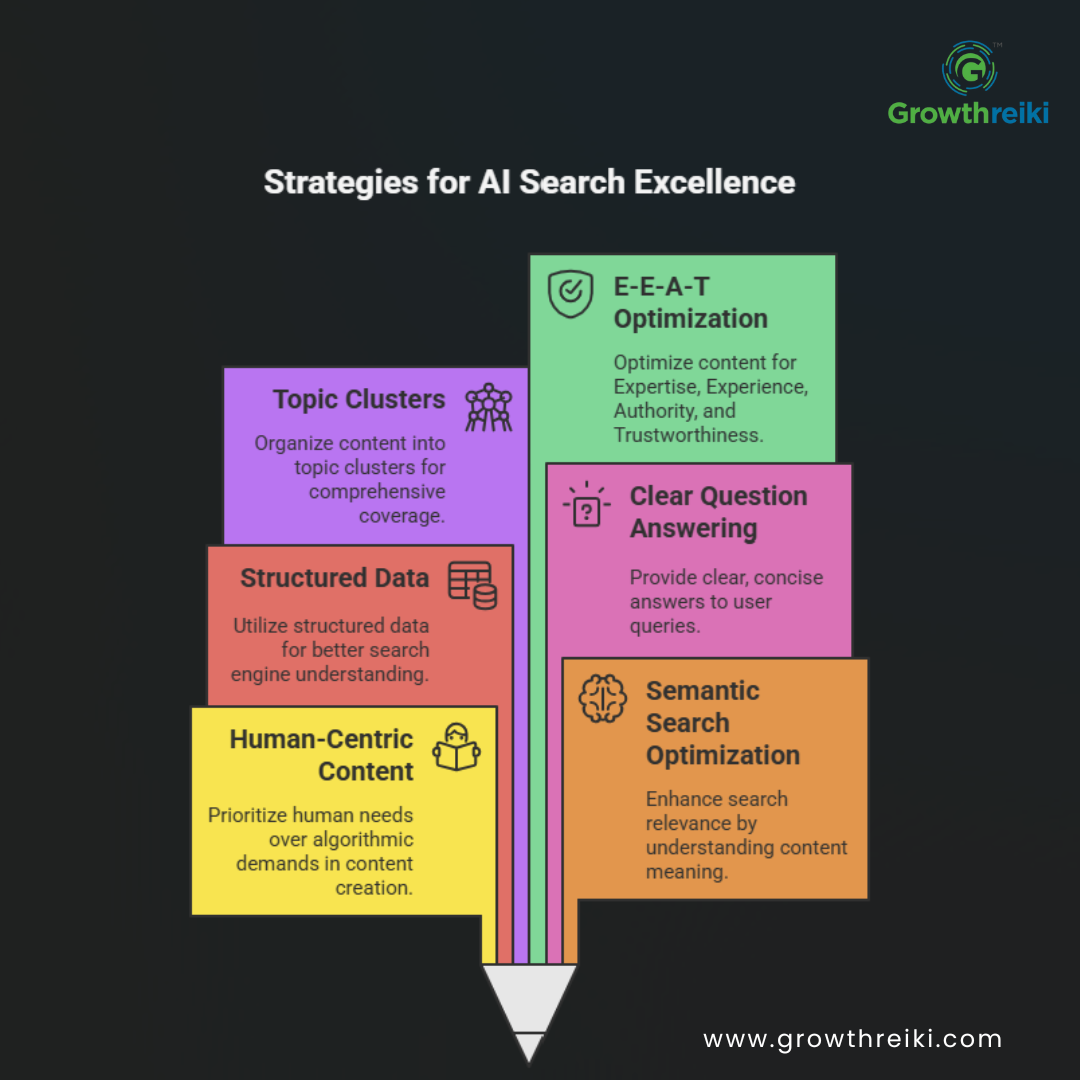
Though AI is slowly taking the steering wheel in content creation and search optimization, the basic foundation of the content remains unchanged. The focus remains on creating explicit, engaging, and informative content that addresses the reader’s genuine questions. But the slight change is it no longer relies solely on keyword density but instead tries to interpret user intent.
It is always better to write down the content based on what the reader might be thinking. For example, if you have a cooking blog, don’t just give away recipes. Start with the basics—what beginners would be searching for, like “How to boil pasta to perfection” or “Essential spices for every Indian kitchen.”
By anticipating your audience’s needs and questions, your content becomes more relevant, more relatable, and ultimately more discoverable.
While AI tools are transforming how we create and optimize content, they’re not a one-size-fits-all solution. Here’s why AI content alone isn’t the silver bullet marketers often expect.
2. Optimize Content for Semantic Search
Semantic search is now gaining attention when it comes to writing content and making it visible for AI searches. Semantic search is a framework that works beyond keyword matching. Instead of just doing keyword stuffing, this technique also takes into consideration the related terms, their synonyms and entities that provide the context behind the keywords.
For example, when you are writing about car rental, you don’t need to do keyword stuffing of the word car rental endlessly. Instead, you should add related terms like vehicle hire, self-drive vehicles, car booking service, and mention rental companies.
It helps search engines better understand the overall character of your content and align it with searches more accurately.
This helps AI to understand your topic thoroughly and connect it to a broader set of questions.
3. Use Structured Data and Schema Markup
To make your content visible to search engines and AI, the basic and most important task is to set up a schema markup. This will increase the chances of your website content appearing at the top of snippets and featured results, and improve voice search visibility. And that’s not all. Don’t forget to add structured data code to your website, as it makes it easier for search engines to understand the content on a page, no matter if it is a blog, a product, an FAQ, or a case study.
4. Answer Questions Clearly
AI searches rely heavily on featured snippets and direct answers. Frame chunks of your content in question form (e.g., FAQs) and answer them in 40–50 words concisely. If you are authoring a blog, then try to answer the reader’s question in the first paragraph itself so that it might have a chance of getting chosen for zero-click results or voice searches.
5. Create a Pipeline of Topic Clusters
To write AI-optimized content, one must follow the same approach as in SEO- show authority. To establish authority among users and search engines, they must not only share helpful information but also ensure that the content is effectively interrelated. In other words, you need to create topic clusters.
Start with a general pillar page and support it with related, detailed subtopics. This type of structure helps AI understand your site’s authority on a subject, improving crawlability and rankings.
6. Optimize for E-E-A-T
Google’s AI algorithms place Experience, Expertise, Authoritativeness, and Trustworthiness (E-E-A-T) front and centre. Add author bios, cite sources, show credentials, and refresh content regularly. This helps AI decide whether your content is valuable and trustworthy.
With tools like Google Gemini Pro and Veo 3 making AI more accessible and intelligent, the search ecosystem is evolving fast. Here’s what’s new in Google’s AI rollout across 73 countries.
7. Combine AI tools with Google Analytics for Optimization
To yield the best result, combine the power of Google Analytics and AI. Start by collecting and structuring your data, and then mix it with AI tools like Google AI Platform or ChatGPT. AI can track user journeys, build insights, and even create predictive segments.
Once these insights are available, you can see what is performing and what is not and based on those results, you can decide what kind of content needs to be written.
Conclusion
AI-driven search is more intelligent, more intuitive, and more user-focused than ever before. The key to AI search optimization isn’t gaming the system — it’s understanding the system. Create helpful, structured, and meaningful content, and the algorithms will reward you. After all, when you write for humans, AI takes notice.